How often should a tail lift be inspected?

A tail lift needs a LOLER thorough examination at least every 6 months if anyone ever rides on the platform, and at least every 12 months if it only ever lifts goods. Wheelchair lifts on minibuses and ambulances lift people, so they’re always 6 months. Because most drivers stand on the platform with the load, most tail lifts end up on 6-monthly examinations.
That’s why you’ll see both numbers quoted - They’re both right, for different tail lifts. The question to ask is simple: does a person ever travel up or down on it?
Tail lift intervals at a glance
Type | LOLER thorough examination | Worth knowing |
Cantilever tail lift, operator rides the platform | At least every 6 months | The most common set-up on rigid lorries and vans |
Cantilever tail lift, goods only | At least every 12 months | Only if nobody ever rides it, and that’s written into your risk assessment |
Column (slider column) lift | 6 months if anyone rides it, otherwise 12 | Common on home delivery and furniture vehicles |
Tuck-under (underslung) or slider lift | 6 months if anyone rides it, otherwise 12 | Low-slung, so prone to grounding damage |
Wheelchair passenger lift on a minibus, ambulance or taxi | At least every 6 months | It lifts people, every time |
Lorry loader crane (HIAB-type) | At least every 12 months | A separate examination from any tail lift. Slings and chains used with it every 6 months |
Any tail lift after it’s been damaged, grounded or repaired | Before it’s used again | LOLER counts these as exceptional circumstances (Regulation 9(3)(a)(iv)) |
These intervals come from LOLER Regulation 9(3)(a): 6 months for equipment that lifts people, 12 months for other lifting equipment. A written examination scheme drawn up by a competent person can set different intervals, for example shorter ones for a tail lift doing 40 drops a day.
Why riding the platform changes everything
On paper, a tail lift lifts goods. In practice, the driver usually stands on the platform with the roll cage or pallet, rides it up to the bed, and rides it back down. The moment a person travels on it, LOLER treats it as lifting people, and the 6-month interval applies.
“Goods only” has to be true every day, not just on the day you set the interval. If your drivers ride it even occasionally, put it on 6 months. It’s simpler, and it’s what the examination is there for.
Is the vehicle’s MOT the same as a tail lift examination?
No. The annual test or MOT checks the vehicle for the road. A LOLER thorough examination is a separate check, by a competent person, that the tail lift is safe to keep using, with a written report. One doesn’t cover the other, so keep both dates.
Many fleets line the tail lift examination up with a scheduled safety inspection, so the vehicle is only off the road once. That’s a sensible way to do it, as long as the paperwork for the tail lift is a proper thorough examination report.
Who’s responsible?
Whoever operates the vehicle. If you own your fleet, it’s you. If the vehicles are on contract hire or lease, the hire company often arranges examinations, but you still need evidence that the tail lift’s examination is in date before it’s used (LOLER Regulation 9(4)). Check your contract says who books them, and ask for copies of the reports.
The driver’s job is the daily check, and reporting anything wrong before the lift is used.
Wheelchair lifts on minibuses
Schools, colleges, care providers, charities and community transport groups often run minibuses with a passenger lift at the back or side. Because it lifts a person in a wheelchair, it needs a thorough examination at least every 6 months, without exception.
They’re easy to forget because the minibus itself gets its MOT, its service and its driver checks, and the lift is assumed to be part of that. It isn’t. If you run a school minibus, our schools page covers the rest of a school’s lifting equipment too.
What a tail lift examination covers
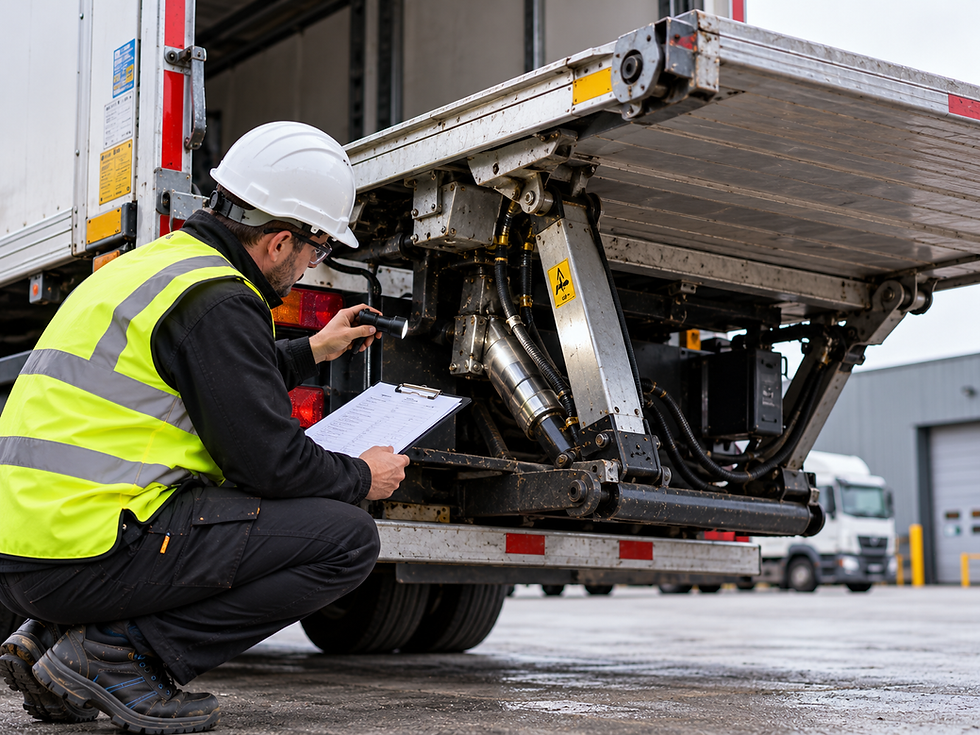
On a typical tail lift, I’ll be looking at:
the platform, for cracks, distortion and damage, and its anti-slip surface
hinge pins, bushes and pivot points
the lift arms or columns, and their mountings to the chassis
hydraulic cylinders, hoses and fittings, for leaks and damage
the controls, including hold-to-run operation and any remote control
safety features: trolley stops, handrails, foot guards and warning lights or flags
chains or wire ropes on column lifts
the safe working load marking
on wheelchair lifts, the barriers, roll-off stops and occupant restraints
A 2-minute daily check
Before the first drop of the day, the driver should check:
the platform is undamaged and its surface isn’t slippery
the controls work, and the lift stops when the control is released
there are no hydraulic leaks or damaged hoses
trolley stops, handrails and warning lights work
the safe working load is marked and readable
If anything fails, the tail lift isn’t used until it’s been looked at.
Tail lift examinations across the Midlands
We examine tail lifts, minibus wheelchair lifts and lorry loader cranes for fleet operators, delivery firms, removal companies, schools and community transport groups across Nottingham, Derby, Leicester, Loughborough and Lincoln, and out to Newark, Mansfield and Grantham. We also travel anywhere in the UK.
Every examination is carried out and signed by me, Ryan Leavesley MSOE MBES, an engineer surveyor with over 14 years’ experience. We don’t sell, fit or repair tail lifts, so we’re never checking our own work. Every vehicle gets its own written report, we contact you before each examination falls due, and once we’ve agreed a price, it stays fixed for all your ongoing examinations.
Tell us how many vehicles you have and what type of tail lifts they’ve got, and we’ll come back with a fixed quote.
FAQs
How often should a tail lift be inspected under LOLER?
At least every 6 months if anyone ever rides on the platform, and at least every 12 months if it only lifts goods. Because most drivers ride the platform with the load, most tail lifts end up on 6-monthly thorough examinations.
Is a tail lift classed as lifting people?
It is if anyone travels on the platform, even occasionally. Drivers often ride up and down with the roll cage or pallet, and the moment that happens, LOLER treats the tail lift as lifting people and the 6-month interval applies.
Does the vehicle’s MOT cover the tail lift?
No. The MOT or annual test checks the vehicle for the road. A LOLER thorough examination is a separate check that the tail lift is safe to keep using, with a written report. Keep both dates in the diary.
Who is responsible for tail lift inspections on a hired lorry?
The business operating the vehicle must make sure the tail lift has an in-date thorough examination before it’s used. The hire company often arranges examinations, but check your contract says so and ask for copies of the reports.
How often should a minibus wheelchair lift be inspected?
At least every 6 months. A wheelchair passenger lift lifts people, so LOLER’s 6-month interval always applies. It’s separate from the minibus’s MOT and servicing, so make sure it has its own thorough examination report.
Does a tail lift need inspecting after it’s damaged?
Yes. If a tail lift has been grounded, hit or repaired in a way that could affect its safety, it needs a thorough examination before it’s used again. LOLER counts damage and major repairs as exceptional circumstances.
What should a driver check on a tail lift every day?
That the platform is undamaged and not slippery, the controls work and stop the lift when released, there are no hydraulic leaks, and trolley stops, handrails and warning lights work. If anything fails, the lift isn’t used until it’s been looked at.

Comments