How often does a vehicle lift need a LOLER inspection: 6 or 12 months?

Every 6 months, in practice. LOLER’s legal minimum for a vehicle lift is 12 months, because it lifts goods rather than people. But HSE says the interval should be set by risk assessment, because people work underneath raised vehicles, and that 6-monthly examination is common practice across the industry. The Garage Equipment Association says the same for MOT stations.
So if you’ve been told 12 months by one company and 6 by another, they’re both quoting something real. Here’s why 6 is the one to go with...
Why the law says 12 but everyone does 6
LOLER sets two intervals (Regulation 9(3)(a)):
at least every 6 months for equipment that lifts people, and for lifting accessories
at least every 12 months for other lifting equipment
A vehicle lift doesn’t lift people, so on paper it sits in the 12-month group. But LOLER also lets the interval be set by an examination scheme, based on risk, and the risk on a vehicle lift isn’t to the car. It’s to the technician standing underneath it.
HSE updated its guidance on vehicle lifts to stress exactly that: the risk to people working below raised vehicles should decide the time between examinations. HSE’s internal guidance to its own inspectors goes further, noting that six-monthly thorough examination is common industry practice for all types of vehicle lift. And the Garage Equipment Association’s 2026 guide to setting up an MOT station says vehicle lifts and jacking beams need examining every 6 months.
From what I see, a garage on 12-monthly examinations isn’t automatically breaking the law. But if anything goes wrong under a lift, “we went with the legal minimum” is a hard position to defend when HSE and the industry both say 6.
Vehicle lift intervals at a glance
Equipment | Legal minimum under LOLER | What HSE and the industry expect | Worth knowing |
Two-post lift | 12 months | 6 months | Arm restraints and pads are checked every time |
Four-post lift | 12 months | 6 months | Any jacking beam fitted is examined too |
Scissor lift (vehicle) | 12 months | 6 months | Includes flush-mounted and mobile scissor lifts |
MOT lift (Class 4 or Class 7 ATL) | 12 months | 6 months | DVSA needs a current LOLER certificate on file |
Jacking beam | 12 months | 6 months | The GEA groups it with lifts for MOT stations |
Mobile column lifts (HGV, bus, van) | 12 months | 6 months | Each column is examined, plus the controls that link them |
Trolley, bottle and transmission jacks | 12 months | 12 months | HSE’s motor vehicle repair guidance says 12 |
A new, moved or reinstalled lift | Before first use | Before first use | Its safety depends on how it’s installed (Regulation 9(2)) |
Any lift also needs examining before it’s used again after damage, a dropped vehicle, a major repair or a long spell out of use (Regulation 9(3)(a)(iv)).
MOT centres: the certificate DVSA wants to see
DVSA’s MOT testing guide lists a current LOLER thorough examination certificate among the requirements for the lift used for Class 3, 4 and 5 underside inspection. So for an MOT centre, a lapsed examination isn’t just a health and safety risk. It’s a problem with the test itself.
Keep each lift’s latest report where you can find it quickly, and put the next due date in the diary with a reminder a month before. We manage your reminders for you so you don't need to worry about missing a date.
New, moved or reinstalled lifts
A vehicle lift is bolted to your floor, and its safety depends on how well that’s done. So LOLER Regulation 9(2) requires a thorough examination after installation and before it’s first used. The same applies if a lift is moved to another bay or another site.
The GEA’s guidance is that the installer shouldn’t carry out that first examination, and the company that services a lift shouldn’t carry out its periodic thorough examinations either. Both would be checking their own work.
What a vehicle lift examination covers
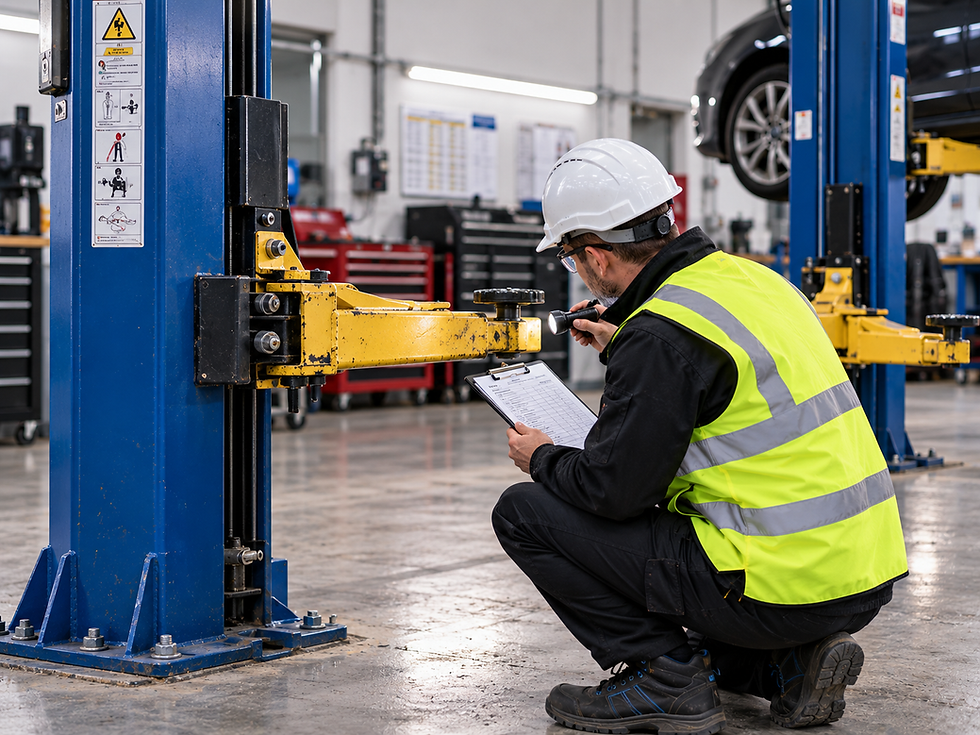
On a typical two-post or four-post lift, I’ll be looking at:
the columns, carriages, arms and runways, for cracks, distortion and damage
arm restraints, pads and adaptors
lifting screws and load nuts, or wire ropes and pulleys, and measuring wear where it matters
hydraulic cylinders, hoses and fittings on hydraulic lifts
mechanical safety locks and catches
equalisation cables and synchronisation
controls, limit switches and the emergency stop
the floor fixings and anchor bolts
the safe working load marking
Servicing isn’t the same as an examination
Most garages have their lifts serviced by the supplier, and that’s sensible. Servicing keeps the lift working. A LOLER thorough examination is the separate, independent check that it’s safe to keep using, with a written report.
HSE says the examiner should be “sufficiently independent and impartial”, and the GEA’s guidance says the person who services a lift can’t carry out its thorough examination. If your lift company does both, ask which visit is which, and check your paperwork says “thorough examination”.
Booking your next examination
We examine two-post, four-post, scissor, MOT and column lifts, plus jacks and engine cranes, for garages, MOT centres and dealerships across Nottingham, Derby, Leicester, Loughborough and Lincoln, and out to Newark, Mansfield and Grantham. We also travel anywhere in the UK, which suits dealer groups with several sites.
Every examination is carried out and signed by me, Ryan Leavesley MSOE MBES, an engineer surveyor with 14 years’ experience. We don’t sell, install or service lifts, so we’re never checking our own work. Every lift gets its own written report, we contact you before each 6-monthly examination falls due, and once we’ve agreed a price, it stays fixed for all your ongoing examinations.
More on our car and vehicle lift inspections page, or see how we work with garages, MOT centres and dealerships. Or tell us how many lifts you have and we’ll come back with a fixed quote.
FAQs
How often does a vehicle lift need a LOLER inspection?
Every 6 months in practice. LOLER’s legal minimum is 12 months because a vehicle lift lifts goods, but HSE says the interval should be set by risk assessment because people work underneath, and 6-monthly examination is common industry practice. The GEA says 6 months for MOT stations.
Is 12 months legal for a car lift?
LOLER’s minimum for equipment that only lifts goods is 12 months. But the interval should reflect the risk to people working below the raised vehicle, and HSE and the garage industry both point to 6 months. If something went wrong, 12-monthly examinations would be hard to defend.
Does an MOT lift need a LOLER certificate?
Yes. DVSA’s MOT testing guide lists a current LOLER thorough examination certificate among the requirements for the lift used for Class 3, 4 and 5 underside inspection. The GEA advises examining MOT lifts and jacking beams every 6 months.
Do jacking beams need a LOLER inspection?
Yes. A jacking beam lifts the vehicle, so it’s lifting equipment under LOLER. The GEA groups jacking beams with vehicle lifts and says both need examining every 6 months at MOT stations.
Does a new vehicle lift need a LOLER inspection before use?
Yes. A vehicle lift’s safety depends on how it’s installed, so LOLER Regulation 9(2) requires a thorough examination after installation and before first use. The same applies if it’s moved to a new position. The GEA says the installer shouldn’t carry out that first examination.
Can the company that services our lifts do the LOLER examination?
The GEA’s guidance says the person who services a lift can’t carry out its thorough examination, and HSE says the examiner should be sufficiently independent and impartial. Using a separate examiner avoids anyone checking their own work.
How often do garage jacks need inspecting?
HSE’s motor vehicle repair guidance says trolley, bottle and transmission jacks should be thoroughly examined every 12 months, and HSE treats garage jacks as lifting equipment. Axle stands and props should be inspected by a competent person every 12 months.

Comments