Do roller shutters and dock levellers need inspecting?

It may be a surprise but powered roller shutters, sectional doors and dock levellers have to be maintained and checked by law, mainly under the Workplace Regulations and PUWER. No law sets a fixed interval, but most sites service powered doors every 6 months and have them inspected at least once a year. A dock leveller designed to lift people falls under LOLER and needs a thorough examination every 6 months.
Loading bays get a lot of attention when something breaks, and very little before. A roller shutter is a heavy steel curtain held up by springs, cables, a motor and a brake. If any of those fail, it comes down. And a dock leveller takes the weight of a loaded forklift several times an hour.
Which law covers what?
Equipment | Main law | Inspection, typically | Worth knowing |
Powered roller shutter or sectional door | Workplace Regulations 5 and 18, plus PUWER where staff operate it as part of their job | Serviced every 6 months, with a recorded competent person inspection at least every 12 months | Safety edges, photocells and the anti-drop device are tested each time |
Manual roller shutter | Workplace Regulations 5 and 18 | Serviced and inspected at least once a year | Springs and counterbalance are the main wear points |
Powered gates and barriers | Workplace Regulations 5 and 18 | Regular checks and maintenance, following the manufacturer’s instructions | HSE’s powered gate guidance applies to industrial doors too |
Dock leveller | Inspected at least every 12 months, often more for busy bays | Lip hinge, hydraulics and welds take the most punishment | |
Dock leveller designed to lift people | Thorough examination at least every 6 months | Check the manufacturer’s information on what it’s designed for | |
Scissor lift table or dock lift that raises goods | Thorough examination at least every 12 months, or 6 if people ride it | It lifts a load, so it’s lifting equipment |
Your own risk assessment sets the final interval. A shutter cycling 200 times a day in a busy distribution centre needs more attention than one opened twice a day on a small unit.
Roller shutters: why the anti-drop device matters
Most roller shutter injuries come from a door coming down when it shouldn’t. That happens when a spring, cable or brake fails and the safety device that should stop the fall doesn’t work. In 2020, the Defence Infrastructure Organisation issued a safety alert after a roller shutter on one of its sites dropped uncontrolled when its motor cable corroded and snapped, and the safety devices didn’t stop it. Nobody was hurt, but it narrowly missed a member of staff. The alert asked for six-monthly servicing plus a 12-monthly competent person inspection, independent of whoever maintains the doors.
That’s a good model for any site. Service the doors, then have someone who doesn’t service them check they’re safe.

What a door and shutter inspection covers
On a powered roller shutter or sectional door, I’ll be looking at:
the curtain or panels, guides and bottom rail, for damage and distortion
springs, cables, drums and the counterbalance
the motor, brake and the anti-drop or fall-arrest device
safety edges and photocells, and that the door stops and reverses when it should
the controls, emergency stop and manual override
fixings to the building, end stops and wind locks
Dock levellers: when do they become LOLER equipment?
A standard dock leveller is a bridge. It raises and lowers its own deck to meet the lorry bed, then a forklift or pallet truck drives over it. It isn’t lifting a load, so it’s work equipment under PUWER, and Aviva’s engineering inspection guidance puts it on a 12-month inspection.
But some levellers are designed to lift people, and some loading bays use scissor lift tables or dock lifts that raise goods to the lorry bed. Those are lifting equipment under LOLER, and need a thorough examination: every 6 months if they lift people, every 12 if they only lift goods.
If you’re not sure which you’ve got, check the manufacturer’s information or the data plate.
What a dock leveller inspection covers
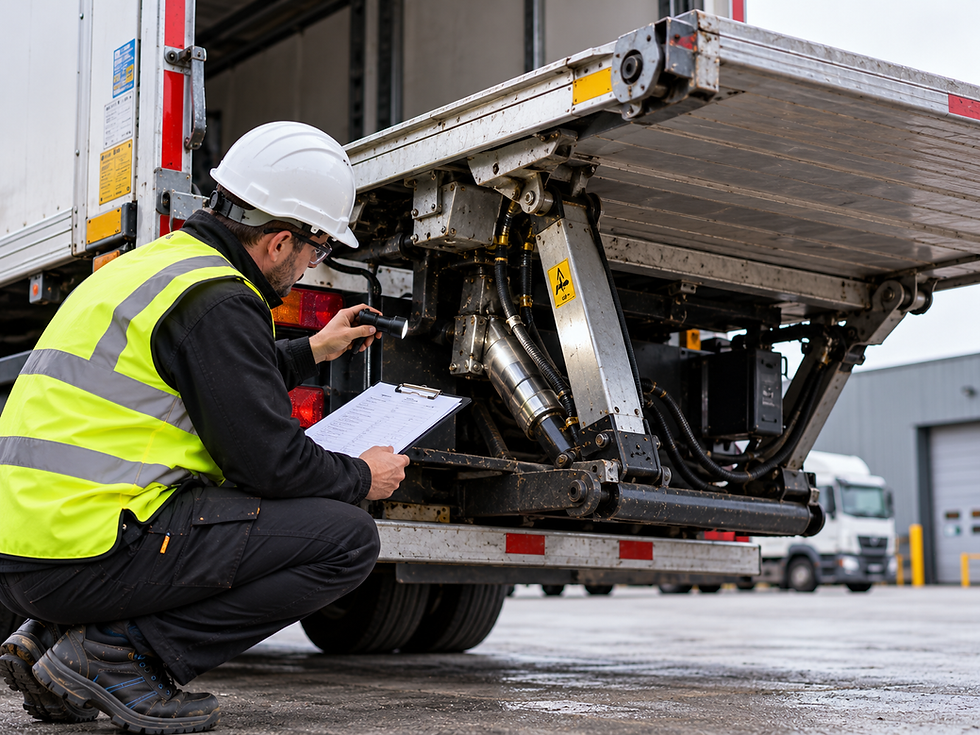
the deck and lip, for cracks, distortion and worn anti-slip surface
the lip hinge and pins
hydraulic cylinders, hoses and the power pack, for leaks and drift
welds at the deck-to-frame joints
the maintenance strut or safety prop, and toe guards
controls and emergency stop
the rated capacity, and whether it still suits the trucks you’re using now
Daily checks for the loading bay
Before the first lorry of the day:
doors open and close smoothly, with no unusual noise or sag
safety edges and photocells stop the door when something’s in the way
the leveller lip extends fully onto the lorry bed
no hydraulic oil on the pit floor
toe guards and side guards are in place
If anything’s wrong, keep that bay out of use until it’s looked at.
Loading bay inspections across the Midlands
We inspect roller shutters, industrial doors, dock levellers and lift tables for warehouses, distribution centres and factories across Nottingham, Derby, Leicester, Loughborough and Lincoln, and out to Newark, Mansfield and Grantham, with the big sheds along the M1 and A50 an easy run from our Nottingham base. We also travel anywhere in the UK.
Every inspection is carried out and signed by me, Ryan Leavesley MSOE MBES, an engineer surveyor with over 14 years’ experience. We don’t sell, install or service doors or levellers, so we’re never checking our own work. You get a written report for each door and bay, and once we’ve agreed a price, it stays fixed for all your ongoing inspections.
If you’ve got forklifts, pallet trucks or a scissor lift on the same site, we can do the lot on one visit. Read does a pallet truck need a LOLER inspection? and how often do you need a PUWER inspection? for more.
Tell us how many doors and bays you have and we’ll come back with a fixed quote.
FAQs
Do roller shutter doors need a PUWER inspection?
Powered roller shutters need regular maintenance and checks under the Workplace Regulations, and PUWER applies too where staff operate them as part of their job. No law sets a fixed interval, but most sites service them every 6 months and have a recorded competent person inspection at least once a year.
How often should a roller shutter door be serviced?
For a powered roller shutter, every 6 months is common practice, more often on a busy door. Manual shutters are usually serviced once a year. Follow the manufacturer’s instructions and your own risk assessment, and keep records of each service.
Do dock levellers need a LOLER inspection?
Usually not. A standard dock leveller bridges the gap to the lorry rather than lifting a load, so it’s work equipment under PUWER, typically inspected every 12 months. A leveller designed to lift people falls under LOLER and needs a thorough examination every 6 months.
Do scissor lift tables at a loading bay need a LOLER inspection?
Yes. A lift table or dock lift raises goods, so it’s lifting equipment under LOLER. It needs a thorough examination at least every 12 months, or every 6 months if anyone rides on it.
What law covers industrial doors and gates?
Mainly the Workplace (Health, Safety and Welfare) Regulations 1992, which require doors and gates to be maintained (Regulation 5) and to be safe, with powered ones having features to stop people being trapped (Regulation 18). HSE says its powered gate guidance largely applies to industrial doors too.
Can the company that services our doors inspect them as well?
They can service and check them, but an independent inspection gives you a second opinion on whether the servicing has kept them safe. A 2020 government safety alert on industrial doors asked for the 12-monthly inspection to be independent of whoever maintains the doors.
What should be checked on a loading bay every day?
That doors open and close smoothly, safety edges and photocells stop the door, the leveller lip extends fully, there’s no hydraulic oil in the pit, and toe guards are in place. Keep the bay out of use if anything’s wrong.
Comments