How often does an overhead crane need a LOLER inspection?

An overhead crane that only lifts goods needs a LOLER thorough examination at least every 12 months. The slings, chains, shackles and other gear hung from its hook need examining every 6 months. A crane also needs examining after installation and before first use, and again after anything that could affect its safety, like damage, a major repair or an alteration.
That’s the same for most cranes you’ll find in a factory, warehouse or workshop: overhead travelling cranes, gantry cranes, jib cranes and monorail hoists. The difference is usually in what’s hanging from the hook, and in the checks that happen between examinations.
Crane inspection intervals at a glance
Type of crane | LOLER thorough examination | Worth knowing |
Overhead travelling crane (single or double girder) | At least every 12 months | The runway and end stops are examined as well as the crane |
Underslung or monorail crane with a hoist | At least every 12 months | The beam and its fixings to the building are part of it |
Gantry crane (fixed or mobile A-frame) | At least every 12 months | Mobile gantries need examining again after being moved and reassembled |
Wall or pillar jib crane | At least every 12 months | Its fixing to the wall, column or floor matters as much as the arm |
Lorry loader crane | At least every 12 months | Separate from the vehicle’s MOT |
Any crane used to lift people | At least every 6 months | Only cranes designed and set up for lifting people should ever do it |
Slings, chains, shackles, lifting beams and other gear used with any crane | At least every 6 months | They’re lifting accessories, with their own dates |
A new, moved or altered crane | Before it’s used | Its safety depends on how it’s installed (Regulation 9(2)) |
These intervals come from LOLER Regulation 9(3)(a). A written examination scheme drawn up by a competent person can set different intervals, for example shorter ones for a crane working three shifts in a steel stockholder.
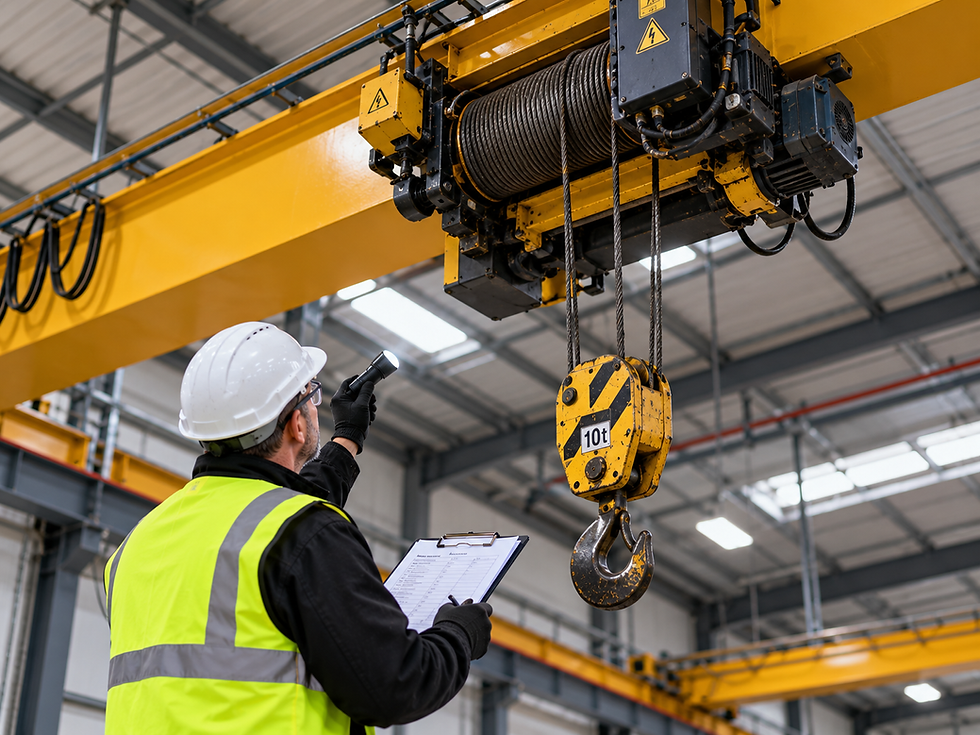
The hook and everything below it
This is where most crane paperwork goes wrong - The crane’s own hook and hook block are part of the crane, on its 12-month examination. But anything you hang from that hook, like a chain sling, a webbing sling, a shackle, a lifting beam or a plate clamp, is a separate lifting accessory. Each one needs its own thorough examination at least every 6 months, and its own record.
So a factory with one overhead crane might have one 12-month date for the crane and a dozen 6-month dates for the gear in the rack next to it. If your last report only lists the crane, ask where the accessories are. More on that on our lifting tackle inspections page.
Inspections between examinations
LOLER also asks for something most people miss. Where a crane is exposed to conditions that could make it deteriorate, it should be inspected by a competent person at suitable intervals between thorough examinations (Regulation 9(3)(b)).
In practice, that usually means:
a quick check by the operator before use, every shift
a recorded inspection at a regular interval set by your risk assessment, often weekly for a busy crane
the 12-monthly thorough examination on top
The inspection doesn’t have to be done by an outside examiner. It can be someone on site who’s trained and knows what to look for, as long as it’s recorded.
When a crane needs examining early
Don’t wait for the 12-month date if:
the crane has been installed, moved or reassembled (Regulation 9(2))
it’s been overloaded, struck or damaged, or dropped a load
it’s had a major repair or alteration, like a new hoist unit, a new trolley or changes to the runway
it’s been out of use for a long time
a pre-use check or inspection finds something that affects its safety
LOLER treats all of these as exceptional circumstances (Regulation 9(3)(a)(iv)).
Does a crane need a load test every year?
Not usually - HSE says most lifting equipment doesn’t need routine testing as part of a thorough examination, and that unnecessary overload tests can damage equipment. The need for a test should be based on risk. A load test is more likely after installation, a major repair or an alteration to a load-bearing part. If someone tells you a crane “needs” a full proof load test every year, ask why.
What a crane examination covers
On a typical overhead crane, I’ll be looking at:
the hook, hook block and safety catch, and measuring hook wear and opening
the wire rope or chain, its terminations and anchor points
the hoist brake and motor
upper and lower hoist limits
the trolley, end carriages, wheels and long travel brakes
the bridge girder, runway beams, rails, end stops and their fixings
the pendant or radio controls, emergency stop and warning devices
the safe working load marking on the crane and hoist
Crane inspections across the Midlands
We examine overhead cranes, gantries, jib cranes and the lifting gear used with them for factories, steel stockholders, workshops and warehouses across Nottingham, Derby, Leicester, Loughborough and Lincoln, out to Newark, Mansfield and Grantham, and into the West Midlands, including Birmingham, Cannock and Tamworth. We also travel anywhere in the UK.
Every examination is carried out and signed by me, Ryan Leavesley MSOE MBES, an engineer surveyor with over 14 years’ experience. We don’t sell, install or service cranes, so we’re never checking our own work. The crane and every accessory get their own written report, we contact you before each examination falls due, and once we’ve agreed a price, it stays fixed for all your ongoing examinations.
More on our crane inspections page. Or tell us what cranes you have and what’s in the lifting gear rack, and we’ll come back with a fixed quote.
FAQs
How often does an overhead crane need a LOLER inspection?
At least every 12 months if it only lifts goods, under LOLER Regulation 9(3)(a). The slings, chains and shackles used with it need examining every 6 months. A written examination scheme can set different intervals, and a crane also needs examining after installation, damage or a major repair.
Does a jib crane need a LOLER inspection?
Yes. A wall or pillar jib crane is lifting equipment, so it needs a thorough examination at least every 12 months if it lifts goods. Its fixings to the wall, column or floor are part of the examination, and it needs examining after installation before first use.
Are slings and shackles covered by the crane’s examination?
No. The crane’s hook and hook block are part of the crane, but anything hung from the hook is a separate lifting accessory. Each sling, chain, shackle or lifting beam needs its own thorough examination at least every 6 months.
Does a crane need inspecting between thorough examinations?
Often, yes. LOLER Regulation 9(3)(b) says equipment exposed to conditions that could make it deteriorate should be inspected at suitable intervals between examinations. For a busy crane, that’s usually a pre-use check every shift and a recorded inspection, often weekly.
Does an overhead crane need a load test every year?
Not usually. HSE says most lifting equipment doesn’t need routine testing as part of a thorough examination, and the need for a test should be based on risk. A load test is more likely after installation, a major repair or an alteration.
Does a crane need examining after it’s moved?
Yes, if it’s been dismantled and reassembled or reinstalled. LOLER Regulation 9(2) requires a thorough examination after assembly at a new site or location, before the crane is used, because its safety depends on how it’s installed.
What happens if a crane fails its LOLER examination?
If there’s a dangerous defect, the examiner tells you straight away and the crane mustn’t be used until it’s fixed. Where there’s an existing or imminent risk of serious injury, the examiner also sends a copy of the report to the enforcing authority. Other defects get a date to be fixed by.

Comments