What happens when you book a LOLER or PUWER inspection with PULO

If you’ve never booked an examination before, or you’re thinking of switching from the firm that maintains your lifts, you probably want to know what you’re signing up for. Here’s the whole process, start to finish. You enquire, Ryan quotes a fixed price, one engineer surveyor examines your equipment, and you get a signed report for each item, usually with photos.
1. You tell us what you’ve got
Use the contact form, ring 07412 957 441 or email technical@pulocompliance.co.uk. You don’t need a perfect list. Equipment type, how many, where it is and roughly when it was last examined is plenty. If you can’t find the paperwork, a photo of the data plate does the job. We reply within 24 hours.
2. You get a fixed quote
Quotes depend on the type of equipment, how many items there are, where you are and how easy they are to reach. Ryan prices it himself. And once you’ve been given a quote, it stays fixed for all your ongoing work, so next year’s visit isn’t a surprise. If you’d like a feel for the numbers first, there’s a page on what drives the cost of a LOLER inspection.
3. We book it in before it’s due
Most lifting equipment needs a thorough examination every 12 months. Anything that lifts people, and every lifting accessory, needs one every 6 months (LOLER Regulation 9). We work out your due dates, contact you ahead of them and fit the visit around your site. Call-out lead time depends on where you are and what Ryan’s diary looks like, but we do try to squeeze in last-minute requests.
4. One engineer surveyor examines your equipment
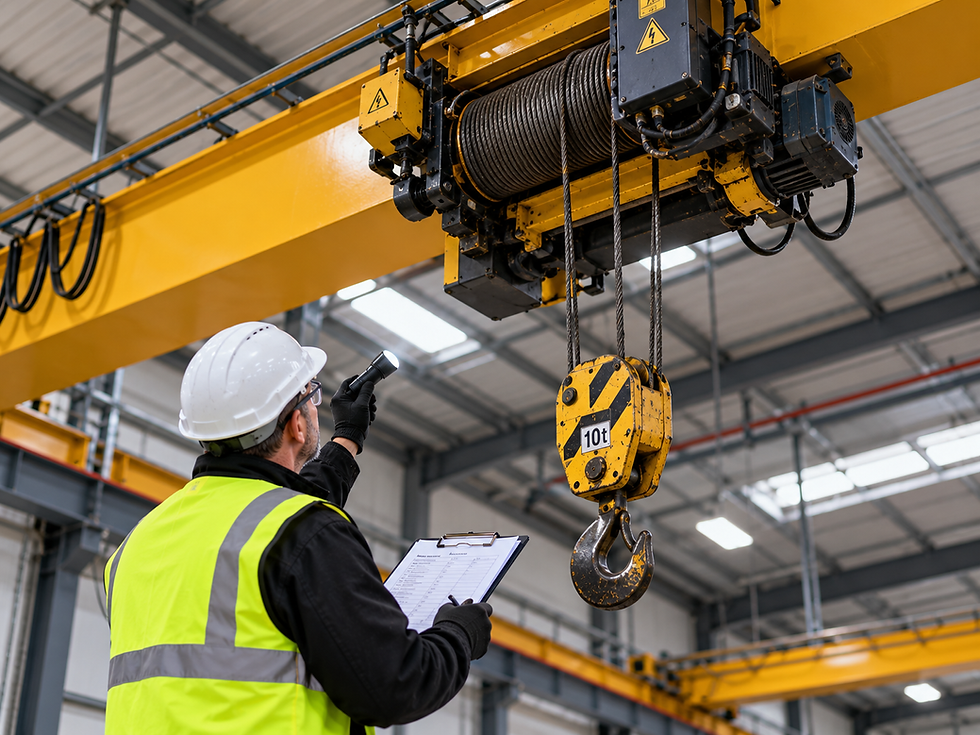
You deal directly with the engineer who does the inspection, and that’s Ryan Leavesley MSOE MBES, an engineer surveyor with over 14 years’ experience. We don’t use subcontractors. We examine each item and we don’t maintain or repair equipment, so there’s nobody marking their own homework. That independence is the point of independent examination.
5. You get a signed report for each item
Each item gets its own Report of Thorough Examination, with photographs, for your service team - you'll get this the same day as our visit. Every report covers the 11 items LOLER Schedule 1 requires, including whether the equipment is safe to keep using and when the next examination is due. You can see exactly what one looks like on the sample report page.
6. If we find a defect
We split every defect into two kinds. Safety-critical defects come with a repair deadline, and everything else is listed so you know what needs attention. If a defect puts someone at risk of serious injury, the regulations (LOLER Regulation 10) also require the examiner to tell the enforcing authority, which is the HSE or your local authority. Ryan will always tell you first and talk you through it. You can read more in what happens if your equipment fails its inspection.
7. Then we remind you for next time
We keep track of your due dates and get in touch ahead of them, so you don’t have to remember. You must keep each report for the period set by LOLER Regulation 11, which depends on the type of equipment. Our sample report page explains how long.
Ready to book?
Get in touch and we'll get back to you usually within 24 hours to confirm a quote.
Frequently asked questions
What do I need to have ready on the day?
Access to the equipment and a person who can show Ryan where it is. For lifts, he may need the machine room open. Any previous reports help.
Does the equipment have to be out of use?
Only while the item is being examined, and for a lift that’s usually a short time. We plan the visit to suit you, and with a block of lifts we can look at one at a time so residents aren’t left without.
Who actually does the examination?
Ryan Leavesley MSOE MBES, or an engineer surveyor you’ve met. We don’t subcontract, and we don’t use template reports.
Can you examine equipment another company maintains?
Yes, and HSE guidance says that’s actually better, because the examiner should be independent of whoever maintains it.
What if I don’t know what needs examining?
Send us what you’ve got. Ryan can tell you what falls under LOLER, what falls under PUWER, and what doesn’t need examining at all. There’s also a guide to what equipment LOLER covers.
What if we’re already with another examiner?
You can switch at any time. We’d ask for your last report so we can pick up your due dates.


Comments