How often do slings, chains and shackles need a LOLER inspection?

At least every 6 months. LOLER Regulation 9(3)(a)(i) puts every lifting accessory, from slings and chains to shackles, hooks, eyebolts and lifting beams, on a 6-month thorough examination. That applies even when the crane or hoist they hang from is on 12 months. Whoever uses them should also check them before every lift.
These are the things that are missed more than any other - A business books its overhead crane in once a year, and the slings and shackles get examined with it. That leaves them 6 months overdue for half of every year... Accessories run to their own schedule!
What counts as a lifting accessory?
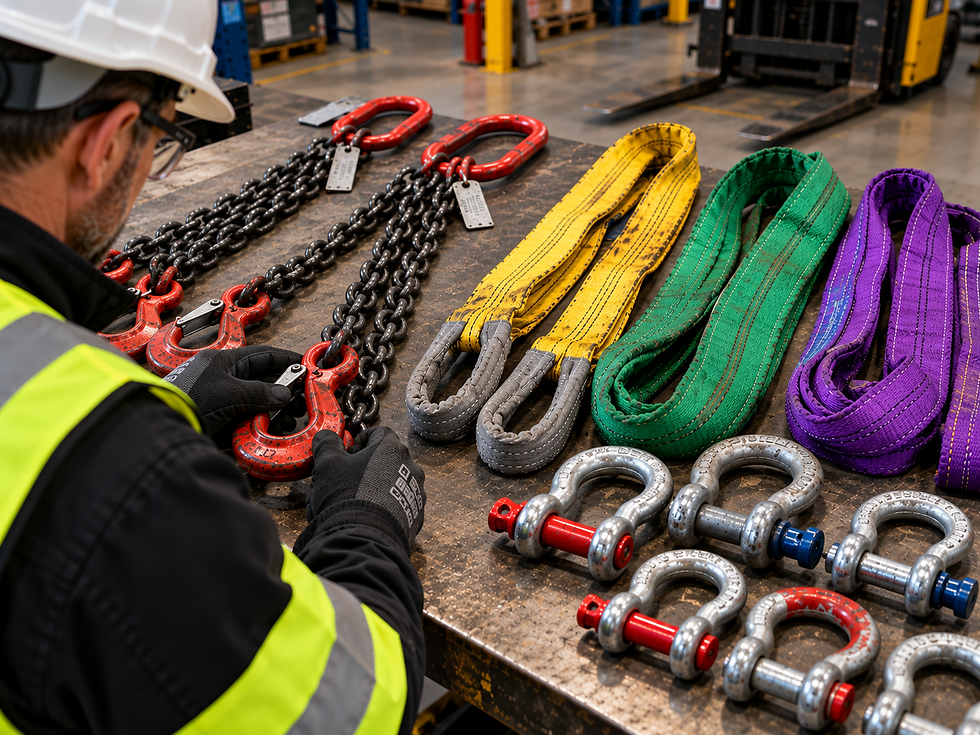
HSE describes a lifting accessory as equipment that attaches the load to the lifting equipment, without being a permanent part of either. In practice that means:
chain slings, wire rope slings, webbing slings and round slings
shackles, hooks, eyebolts and swivel hoist rings
beam clamps and plate clamps
lifting beams and spreader beams
patient hoist slings in care homes and hospitals
Things that are usually part of the load, like pallets and skips, aren’t accessories under HSE’s guidance. They still need to be kept in good condition.
Every accessory: how often, what to check, what fails
Accessory | Thorough examination at least every | Check before every use | Common reasons it fails |
Chain sling | 6 months | Links, hooks, safety catches, ID tag | Stretched or twisted links, opened hooks, mixed components, missing tag |
Wire rope sling | 6 months | Broken wires, kinks, ferrules, eyes | Broken wires, kinks or crushing, damaged ferrules |
Webbing or round sling | 6 months | Cuts, stitching, the label | Cuts, heat or chemical damage, a missing or unreadable label |
Shackle | 6 months | Correct pin, fully screwed in, no bending | Bent body or pin, wrong pin fitted, worn threads |
Hook | 6 months | Throat opening, safety catch | Opened throat, missing or broken catch, cracks |
Eyebolt or hoist ring | 6 months | Threads, seats fully, right direction of pull | Damaged threads, bent eye, used at an angle it isn’t rated for |
Beam or plate clamp | 6 months | Jaws, teeth, locking mechanism | Worn teeth, damaged lock, distortion |
Lifting or spreader beam | 6 months | Welds, lifting points, SWL marking | Cracked welds, distortion, no safe working load shown |
Patient hoist sling | 6 months | Stitching, loops or clips, the label | Frayed loops, a faded or missing label, wash damage |
A competent person can set different intervals in a written examination scheme (Regulation 9(3)(a)(iii)), but it rarely suits accessories. More on that in LOLER written scheme of examination explained.
Why the 6-month date gets missed
In my experience, it’s nearly always one of three things:
The accessories are booked in with the crane or hoist. The machine is on 12 months, so everything gets done once a year.
The accessories aren’t on site on the day. Slings and shackles live in vans, site containers and crane cabs. If they’re out on a job, they’re missed.
Nobody knows exactly how many there are. “Various slings” on a register doesn’t tell you which one is overdue.
The fix is simple: Keep a register with every accessory’s ID number and next date, and gather everything in one place before the examiner arrives, vans included.
What should you check before every lift?
HSE says lifting accessories don’t normally need formal inspections between thorough examinations, as long as proper checks are made before use. Those checks are the user’s job, and they take seconds:
Can you read the ID tag or label, and does it match your register?
Is the safe working load right for this lift, at this sling angle?
Any cuts, kinks, broken wires, stretched links or damaged stitching?
Do the hooks have working safety catches?
Is the shackle pin the right one, and fully screwed in?
Is the accessory still in date?
If the answer to any of those is wrong, don’t use it. Put it aside where nobody else can pick it up, and label it. A damaged sling left in the corner of the workshop has a habit of finding its way back into use.
Is a colour code enough?
No. LOLER Regulation 7 requires accessories to be marked so you can identify what you need to know for safe use, which means the safe working load. HSE’s view is that colour coding alone isn’t normally acceptable. A colour code tells you which examination period an accessory belongs to. It doesn’t tell you the accessory is undamaged, or right for the lift you’re about to do. Use it as a quick visual on top of a proper ID tag and register, not instead of one. There’s more in our LOLER colour code guide.
When do accessories need examining sooner?
The 6-month date is the longest you can go without anything else happening. Accessories need examining again before use after anything that could affect their safety (Regulation 9(3)(a)(iv)), such as:
an overload, a shock load or a dropped load
heat or chemical damage
a repair or modification
a long spell in storage, especially somewhere damp
New accessories don’t need a thorough examination before first use if they come with a Declaration of Conformity issued within the last 12 months, according to HSE. Check the paperwork matches the item, and add it to your register.
Hired or borrowed accessories must come with physical evidence of their last thorough examination before you use them (Regulation 9(4)). If it isn’t there, don’t use them.
Does every accessory need its own report?
Every accessory needs to be identifiable and traceable to its examination record. In practice, each one has a unique ID number on a tag, and each one appears on the report.
I write a separate report for every item, on site, before I leave. If something fails, you’ll know exactly which sling it was, why, and what to do about it. For how to keep track of it all, see do you need LOLER software or will a spreadsheet do?
Lifting accessory inspections across the East Midlands
We examine slings, chains, shackles, hooks, eyebolts, clamps, lifting beams and patient hoist slings for workshops, warehouses, construction firms, care homes and factories. We cover Nottingham, Derby, Lincoln, and the Midlands. We also travel anywhere in the UK.
Every examination is carried out and signed by me, Ryan Leavesley MSOE MBES, an engineer surveyor with over 14 years’ experience. We don’t sell, hire or repair lifting equipment, so nothing we find is a sale. We contact you before each examination falls due, and once we’ve agreed a price, it stays fixed for all your ongoing examinations.
More on our lifting tackle inspections page. Or tell us roughly what you’ve got and we’ll come back with a fixed quote.
FAQs
How often do lifting accessories need a LOLER inspection?
At least every 6 months. LOLER Regulation 9(3)(a)(i) sets a 6-month thorough examination for all lifting accessories, including slings, chains, shackles, hooks, eyebolts and lifting beams, unless a competent person has drawn up an examination scheme that sets a different interval.
Do slings need checking before every use?
Yes. The person using a sling should check it before every lift for cuts, damage, a readable label and the right safe working load. HSE says accessories don’t normally need formal inspections between examinations, provided these pre-use checks are done properly.
Can slings and shackles be examined every 12 months with the crane?
No. The crane or hoist may be on a 12-month examination, but its lifting accessories need examining at least every 6 months. Booking them all in once a year leaves the accessories overdue for half of every year.
Are patient hoist slings lifting accessories?
Yes. Slings used with patient hoists in care homes and hospitals are lifting accessories, so they need a LOLER thorough examination at least every 6 months, along with the hoist. They should also be checked before every use.
Is a colour code enough to show a sling is in date?
No. LOLER requires accessories to be marked with what you need to know for safe use, such as the safe working load. HSE says colour coding alone isn’t normally acceptable. Use it alongside an ID tag and a register, not instead of them.
Do new slings and shackles need a thorough examination before use?
Not usually, if they come with a Declaration of Conformity issued within the last 12 months. Check the paperwork matches the item, check it for transport damage, and add it to your register with its next examination date.
What should I do with a damaged sling?
Stop using it straight away, label it as defective and store it where nobody else can pick it up. Most damaged slings are destroyed rather than repaired, so they can’t find their way back into use.


Comments